The Verdict
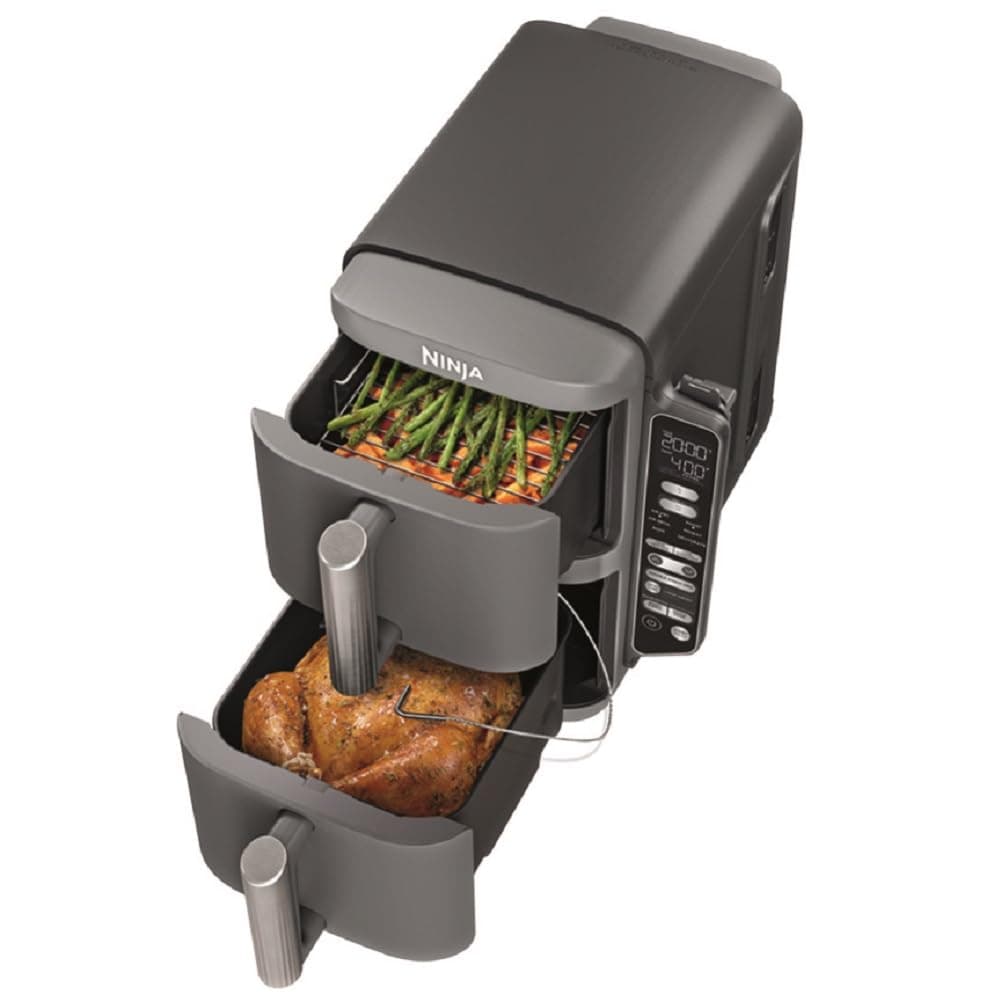
The Ninja DoubleStack XL is a clever solution to a real problem: the sprawling footprint of high-capacity air fryers. It successfully delivers the ability to cook four distinct items at once in a slim, vertical package that reclaims valuable counter space. While it earns a 'Worth It' rating for this innovative design and high user satisfaction on Amazon, buyers should be aware of its primary quirk. The rear-mounted heating element demands more hands-on attention—shaking and rotating food—than top-heating models to achieve an even cook. For those prioritizing space over a set-it-and-forget-it experience, the trade-off is justifiable.
For kitchens where counter space is the ultimate luxury, the DoubleStack's vertical orientation is a genuine game-changer, unmatched by conventional side-by-side models.
What Went Viral
The Ninja DoubleStack XL exploded on TikTok for one simple, visual reason: it goes up, not out. Videos with millions of views show creators unboxing the tall, narrow unit and effortlessly sliding in four separate trays of food. The core appeal, repeated in countless captions, is its ability to deliver the capacity of two air fryers in the footprint of one. Influencers highlighted its utility for big families, meal prep, and cooking entire meals simultaneously—no more "waiting for the fries to finish while the chicken gets cold." The promise of a full-featured, 10-quart air fryer that doesn't dominate your countertop was a powerful hook that resonated with anyone tired of kitchen clutter.
What the Comments Actually Say
Beneath the glossy TikTok promotions, a more nuanced picture emerges from user reviews on Reddit and YouTube. While the 4.6-star Amazon rating shows widespread satisfaction, deeper discussions reveal consistent trade-offs.
Reddit users are the most vocal about the unit's primary flaw: uneven cooking. Multiple commenters in r/airfryer point out that the rear-mounted heating element can leave the front half of the basket undercooked. One user stated, "On several occasions I've had half the food in the drawer cooked and the other half undercooked." Others report that cooking times can be significantly longer than expected, especially when both baskets are in use. Loud operation and aggressive beeps are another common annoyance.
On the positive side, the space-saving design is almost universally praised. A Reddit user noted it "stacks up instead of taking up a ton of width," making it ideal for small kitchens. The convenience of the Smart Finish and Match Cook features also receives high marks for coordinating meal times.
YouTube reviewers echo this sentiment. While praising the capacity and slim profile, several critical reviews point out that achieving an even cook requires more frequent shaking and rotating than with other air fryers. The consensus is that while the concept is brilliant, the execution has a learning curve.
Technical Comparison
The DoubleStack's core innovation is its vertical, dual-basket system with included racks, allowing up to four cooking layers. This stands in stark contrast to the industry standard for dual-zone air fryers, which typically feature two baskets arranged side-by-side. A standard 8 or 10-quart dual-basket model can easily occupy over 15 inches of horizontal counter space. The Ninja DoubleStack, by comparison, is significantly slimmer.
The trade-off is basket geometry. Standard models have wider, more open baskets that allow for better heat circulation from a top-down element. The DoubleStack's deeper, narrower baskets, combined with its rear-mounted heating element, create the potential for hot spots at the back and cooler spots at the front, necessitating the aforementioned user intervention.
The Catch
The product's biggest compromise isn't mentioned in the slick TikTok ads: the heating element is at the back, not the top. This design choice, likely necessary for the vertical stacking mechanism, is the root cause of the most common user complaint. Unlike top-down air fryers that provide more even heat exposure, the DoubleStack functions more like a small convection oven, blasting heat from back to front. This means food closest to the rear of the basket cooks much faster, and failing to shake or rotate the contents midway through can result in a dish that's simultaneously burnt and undercooked.